Growth and scaling are two terms that are often used interchangeably in the context of business development, but they have different meanings and implications. Both may be important objectives for companies of any size, but they require different strategies and techniques, and those practices will certainly drive different outcomes, benefits, and risks.
The (Traditional Slow) Growth Operating Model
Growth, defined for this discussion, refers to increasing the revenue or market share of a business while ramping up assets and resources that help to build revenue streams. Companies that are built around a ‘growth’ operating model can add much cost to generate greater revenue. Some business model examples you might recognize as slow growth include medical practices, traditional post-secondary education models, consulting and other professional firms that operate through a trade-time-for-money model, many resource-intensive industries, and business models that have manual efforts by staff and contractors and/or high knowledge elements. Many traditional bricks-and-mortar operations that require optimization of time and space with people are also tied to this form of a traditional growth model.
The Scaling Model
Scaling refers to increasing the efficiency or profitability of a business that can lead to rapid growth. Companies that invest in scaling practices may invest smartly in leadership, systems, and culture development to avoid introducing ongoing costs while still driving revenue growth. Operating profits in a scaling company may have potential to generate higher free cash for reinvestment and accelerated growth. Scaling is the process of growing a business to meet increasing demand, reach new markets, and achieve greater impact. It’s not just about growing bigger, but also about growing smarter, faster, and more efficiently. Scaling requires a strategic vision, a flexible mindset, and a willingness to innovate and experiment. Scaling also involves overcoming various challenges and risks, such as managing complexity, maintaining quality, ensuring alignment, and fostering culture.
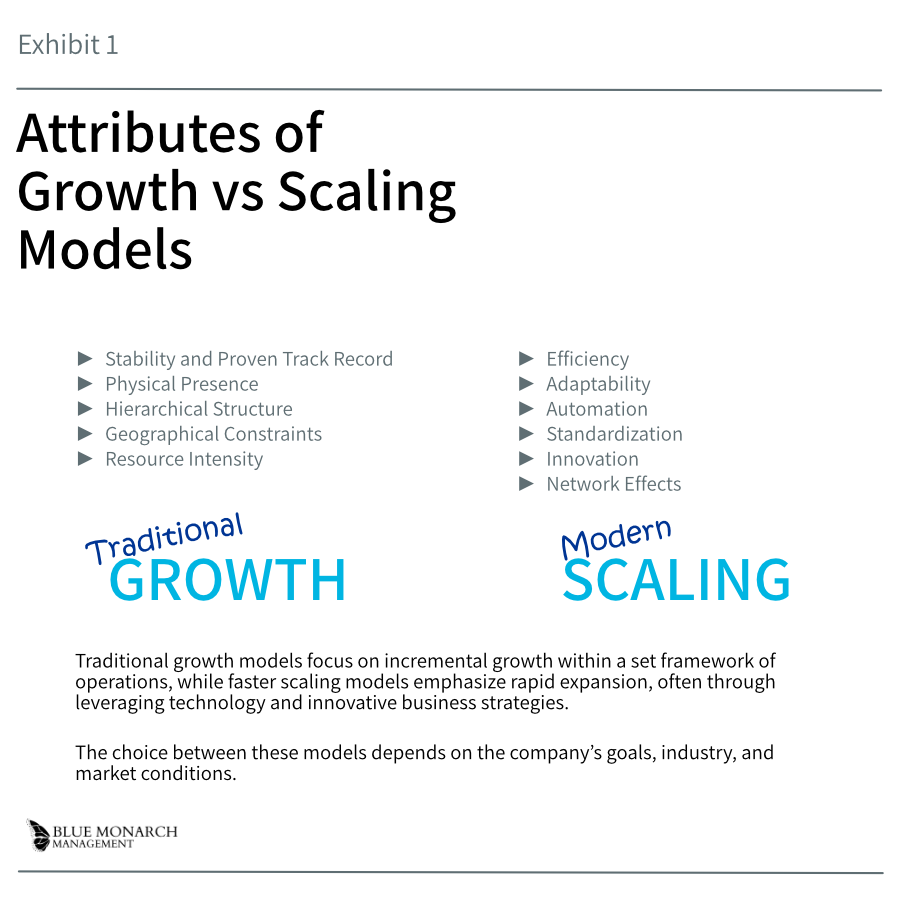
True scalability involves adding revenue at a much greater rate than costs, ensuring efficient expansion without compromising quality or profitability.
Scaling within medium or large-sized enterprise has been an area of professional interest since my days working within the railroad industry. Following the 2008/2009 global financial crisis and further ongoing disruption in global commodity markets, the ability to grow profit has depended increasingly on international market selection, cost management, productivity, demand, and capacity. These optimization investment trends are pervasive in resource and asset intensive industries such as transportation, energy, mining, and manufacturing.
We have also been working with a more entrepreneurial client base whose primary aspirations are to transform their companies repeatedly and iteratively through innovation, great positioning, and relationship management, while either entering or creating new markets facing incredible pressures and disruptive forces. These companies consistently aspire to chase high growth through relentless innovation in what they perceive as untapped opportunities to solve well-known business problems.
Scaling a business is not a one-size-fits-all process. It depends on various factors, such as the type, stage, and industry of your business, the size and nature of your market, the preferences and expectations of your customers, and the availability and suitability of your resources and capabilities.
Should you Scale?
The strategy and business cases to scale an organization should ask and attempt to answer these and other questions first – all focused on answering ‘why’ first, before getting to ‘how’ and ‘when’.
Strategic Thoughts
- Do you think your products, services and operating model can create a sustainable competitive advantage for you? What is your revenue and profit potential? What problems can you solve?
- What market(s) should you select and is there a strong trend that will help you to quickly build momentum for profitable and fast growth?
- Why do you want to grow? Are you (perhaps naively) chasing the “Unicorn” dream to be “the next…”?
- Have others paved the way before you or do you have potential to be a market leader?
- Do your plans follow rigorous business fundamentals or are you pursuing some ‘implied growth imperative’?
- What happens if you fail and where are your potential failure points? How can you manage those risks?
Practical Matters
- How will you resource your rapid growth with people, funds, and time and what value are you potentially negotiating away?
- Can you establish sufficient working capital to build control and stability into your growth?
- What investments in projects and initiatives should you make and when?
- Will you create ongoing dependencies on investors for revenue and funds to continue your operations?
- How will you establish and build the right relationships with banks and other financial institutions to power your growth and manage sustainable operations and risk?
- What leadership structures and cultures will you need to develop…and when…to power your growth?
Ethics and Morality: Sustainability Considerations
- What ethics and morality principles should you follow around staffing and labour practices, particularly in higher risk / higher rewards growth scenarios?
- What are your obligations to your people as your growth potentially outpaces your systems, infrastructure, and culture development?
- What are your obligations to your communities as you develop and position your products and services in untapped markets?
Conclusion
The nature of growth, positioning, and scaling companies will be the topic of a series of posts by Blue Monarch Management over the coming weeks. We will continue to develop narratives around investment in systems, people, leadership, culture, and strategic analysis.
Jeff Peterson is the Founder and CEO of Blue Monarch Management and is a professional Management Consultant specializing in Strategy, Governance, and Organizational Development for companies designing and driving transformational investments.